As far as we know, human beings are the only creatures who are aware that they will die some day and who feel fear when contemplating their eventual demise. This makes the fear of death a uniquely human characteristic and a timeless subject of investigation. What is the proper attitude toward death? Is it rational to fear death, and how does one deal with the terror of what lies beyond?
I will try to shed some light on this subject by comparing Sam Sheffler’s recent analysis of the fear of death with the ancient account offered in Plato’s Phaedo. I argue that Scheffler’s argument, while bringing to light a deep connection between our values and our mortality, is incomplete because it misses the transformation of values that can emerge from a confrontation with the fear of death. This shift in values, which Plato describes as a form of catharsis, is the focus of Socrates’s teaching in the Phaedo and offers a useful counterpoint to Sheffler’s view.
One of the most fascinating recent treatments of the fear of death comes from the NYU philosopher Sam Scheffler. In his book Death and the Afterlife (2013), Scheffler poses an intriguing thought experiment: what would happen if we knew that we would live out our full lifespan, but the entire human race would be wiped out by a catastrophe thirty days after we died? Or, in a slight variation inspired by Children of Men, what if we knew that everyone on Earth would live out their full lifespan but no more children would be born?
Scheffler dubs these the “doomsday” and “infertility” scenarios and uses them to draw insights about value theory — the study of what we value and why. For Scheffler, “the afterlife” refers not to one’s own survival after death (the personal afterlife), but to the continued survival of humanity (the collective afterlife). He argues that the knowledge that humanity would perish after our death, even though it would not directly impact our own lifetime, would undermine our values in profound ways. For example, we might no longer see the point in searching for a cure for cancer, or trying to write a classic novel, or building a future for our children. If this is true, it suggests that the motivation for our actions is dependent on our community and is less egoistic than commonly assumed.

In the final essay in his book, “Fear, Death, and Confidence”, Scheffler turns to examine the personal fear of death — the flip side to his reflection on the collective afterlife. Is death an evil for us, and is it reasonable for us to fear death? His reflection takes off, not from Plato, but from another ancient authority on the fear of death — Epicurus. Epicurus famously argues that death is not an evil or something to be feared:
So death, the most terrifying of ills, is nothing to us, since so long as we exist, death is not with us; but when death comes, then we do not exist. It does not then concern either the living or the dead, since for the former it is not, and the latter are no more. – Epicurus
Scheffler identifies two conclusions in the Epicurean argument: 1) that death is not an evil for us, and 2) that it is unreasonable to fear death. He ends up agreeing with Epicurus that death is not an evil. In fact, he goes even further by arguing that death is a necessary condition for our lives to have meaning. On the other hand, he parts ways with Epicurus on the claim that death is not be feared. For Scheffler, the termination of the perceiving self is a good reason for terror. He characterizes efforts to provide comfort from this terror as lame attempts at “using metaphysics to fight fear.”
Why does Scheffler believe that death is not an evil? He considers and rejects arguments to the contrary by Thomas Nagel and Bernard Williams that death. Specifically, he rejects the “deprivation theory” argument that death is harmful because it deprives us of general goods such as activity, thought, perception and desire. Instead, he focuses on William’s claim that an immortal life would be a meaningless one. While Scheffler finds fault with William’s arguments, he is in full agreement with his conclusion. He offers his own reasons to believe that death is necessary for a meaningful life.
Here is how Scheffler sums up his conclusion: “I have been arguing that our confidence in our values depends on our status as mortals who lead temporally bounded lives and that immortality would undermine that confidence.” For Scheffler, all of the things that we care about in life rest on the assumption that our life is finite and has temporary stages such as birth, adolescence, and adulthood. Our strivings and accomplishments in life are intimately connected to these finite stages (e.g., graduation, marriage, career milestones) and throughly suffused with the assumption that life will end one day. Without a temporal limit or sense of progression, our lives would lack any goal posts or mile markers and our values would lose their meaning.
Scheffler is unable to imagine a form of immortality that would be worth wanting. Whether we imagine a series of psychologically disjointed lives (effectively, a series of rebirths), an infinite life while remaining the same age, or an incorporeal life totally unlike ordinary life on earth, he argues that the same problem would arise. Just as most of our projects and goals in life assume that humanity will continue after we die, they also assume that our individual lives will come to an end. Life without personal death undermines our values in the same way that life without a collective afterlife does. As I will explain later, I believe that Scheffler suffers from a lack of imagination about what an incorporeal life could be like.
If immortality is undesirable, why is it still reasonable to fear death? Scheffler’s prima facie argument is that it can be reasonable to fear things that are necessary or even good for us, such as a painful dentist appointment. If fear is a response to a threat and the unwanted end of one’s existence may reasonably be perceived as a threat, then it is reasonable to fear death. While death may be necessary, it doesn’t mean that we can’t fear the painful process of dying or the ultimate destruction of the egocentric self.
To defend his prima facie argument, Scheffler rebuts several arguments for why it might not be reasonable to fear death. For example, some might argue that the egocentric subject itself is an illusion. Even if this is true, Scheffler argues that it is still reasonable to believe in an egocentric subject, and even if it were not, discovering that the self never existed in the first place would likely be more alarming than the prospect of that self being destroyed.
Nor is Scheffler impressed by the attempt to show that the “fear of death” is not properly fear at all. On this argument, propositional fear (the fear that something or other will occur) must be distinguished from the state of fear, which is an involuntary physiological reaction that is neither reasonable nor unreasonable. Logically speaking, one cannot have a propositional fear of something that is already known to be the case. For example, we cannot fear that it is going to rain on our vacation if it is already happening. At most, the argument claims, the fear of death is not really “fear” but a kind of dread. This is silly, Scheffler contends, because replacing fear with dread offers little in the way of comfort.
Scheffler acknowledges the tension between the attitudes that 1) death is not an evil for us, but that 2) nonetheless, it is reasonable for us to fear death. He calls this a “strange and unsettling position”, but one that he believes is warranted and unavoidable. He shows that our values and our confidence in them are heavily dependent on both our personal mortality and the ongoing survival of our species. But in Sheffler’s eyes, philosophy is impotent to free us the fear of death, which is a natural and reasonable reaction to the end of our subjectivity. Does this leave us prisoners to our fear? And could there be a form of immortality worth wanting?
I will now turn to Plato for a counterpoint to the “unsettling” view that Scheffler advances in his book. In the Phaedo, Plato recounts Socrates’s last day in prison before being put to death by the Athenians. As the dialogue begins, Socrates’s friends are astonished that he seems totally unperturbed by his imminent death. They accuse him of being foolish for going so blithely to his death and being careless for so easily abandoning his friends.
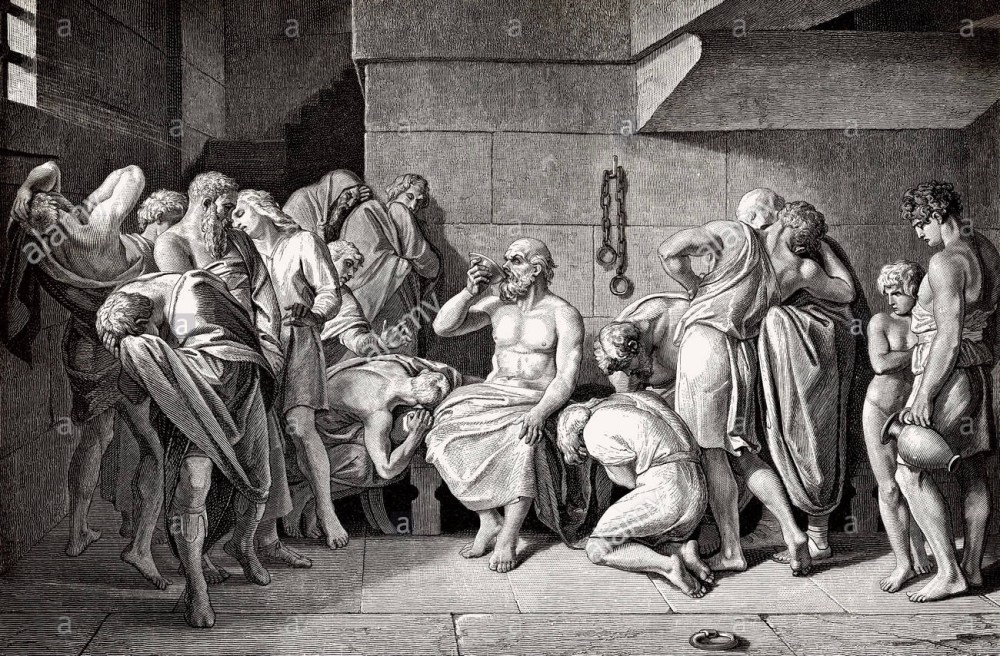
Socrates gives a very odd defense of his placid attitude toward death. He claims that death is nothing more than the separation of the soul from the body and that the entire purpose of philosophy is to practice for death by freeing the soul from the body. Therefore, he greets death as a blessing and the fulfillment of his lifelong mission.
This argument, his friends complain, assumes that the soul will survive once it leaves the body — an assumption that seems impossible to prove. Like Scheffler, Socrates’s friends have trouble imagining life apart from the body. Socrates nonetheless attempts the feat of proving the soul to be immortal in order to calm their fear of death. The setting of the dialogue on the anniversary of Theseus’s voyage to slay the Minotaur emphasizes the heroic and legendary character of Socrates‘s deeds, as he attempts to save the youth of Athens by leading them through a labyrinth of argument towards a confrontation with death.
Taken at face value, the arguments that Socrates musters to prove that the soul is immortal are highly suspect. Scheffler would likely classify them as “using metaphysics to fight fear”. For example, the first argument claims that because it is logically necessary for things to come into being from their opposites (e.g., if something is coming to be hot, it must have been cold; if something is coming to be big, it must have been small; if coming to be alive, it must have been dead), the souls of the living must have come from souls of the dead. Therefore, the souls of the dead exist.
As specious as this may seem, this argument makes a important distinction between being and becoming. To wit, we can only know that something is coming to be cold if we have a concept of what it is to be cold. Through these “proofs”, Socrates begins to draw a distinction between the soul and the body and helps us envision what a pure soul – the soul without the body – would be like. He separates the body from the soul, not physically, but logically. His rational arguments are playfully intertwined with myths about the soul’s journey into the underworld, the journey that Socrates himself is about to make.
Now with the stage set, I want to focus on the part of the Phaedo where the fear of death comes to the forefront. After his first two arguments, Socrates’s friend Cebes complains that, while it has been proven that the soul existed before we were born, it has still not been proven that the souls will exist after we die. To this complaint, Socrates responds:
What you speak of has then even now been proved. However, I think you and Simmias would like to discuss the argument more fully. You seem to have this childish fear that the wind would really dissolve and scatter the soul as it leaves the body, especially if one happens to die in a high wind and not in calm weather.
Cebes laughed and said: Assuming that we were afraid, Socrates, try to change our minds, or rather do not assume that we are afraid, but perhaps there is a child in us who has these fears; try to persuade him not to fear death like a bogey.
You should, said Socrates, sing a charm over him every day until you have charmed away his fears. (Phaedo, 77d-e)
This is an important moment in the dialogue. What has been presented as a dispassionate investigation of the soul (psyche) is revealed to be motivated by a childlike fear of the ultimate bogeyman — death. The interlocutors, Cebes and Simmias, ask Socrates to aim his persuasive powers at this inner child.
Socrates obliges with a reincarnation myth, an Aesopian fable, which purports to show that how we live determines the form that we will take in our next life. Like all Platonic myths, this one mixes logos (argument) and mythos (storytelling) into a potent rhetorical elixir.
The logical part of the story is a distinction between the visible and the invisible. According to Socrates, the visible is changing, composite, and perishable, while the invisible is changeless, uniform and eternal. The former is known through the senses; the latter through the mind. The former is naturally ruled; the latter is naturally ruler. Socrates argues that the soul’s nature is akin to the invisible and divine and therefore resistant to the decay that we observe in all visible things.
However, the mythological element adds another dimension. According to Socrates, it is not all souls that dwell in the divine realm of the invisible after death. It is only the souls that have been purified through the love of wisdom that can complete this journey. Philosophy is training for death and teaches the soul to live without the body, without confusion by the senses and appetites. The soul needs care and education in order to collect itself from its somatic entanglements and avoid falling back into a body.
In the myth, the souls of ignorant men wander the underworld of Hades until they are again imprisoned in a body that suits the character they had practiced in life. The gluttonous and drunken become donkeys; the tyrannical and violent become wolves and hawks; those who pursue popularity and social validation (today’s Instagram influencers) become bees and ants; and so forth.
As a literal story about what happens when we die, the myth is hard to take seriously. But as an Aesop’s fable, the moral is clear enough: our values and desires determine who we become — in this life and the next. Appetitive desires make us like animals, while the desire to know makes us like gods. For Plato, the love of learning helps us choose our values wisely and break the bonds of tyrannical desires:
“I will tell you, he said. The lovers of learning know that when philosophy gets hold of their soul, it is imprisoned in and clinging to the body, and that it is forced to examine other things through it as through a cage and not by itself, and that it wallows in every kind of ignorance. Philosophy sees that the worst feature of this imprisonment is that it is due to desires, so that the prisoner himself is contributing to his own incarceration most of all.” (82d-e)
Socrates suggests that humans live in a self-made prison of desires. Before one starts to philosophize, values are determined by whatever causes pleasure or pain. We naturally consider things that bring pleasure, such as sex, food and social praise, to be the most real and valuable things there are to pursue. This attitude chains us to the body and prevents us from imagining ourselves as anything more.
Socrates urges his companions to purify the soul by cultivating a love of learning and being detached from pleasures of the body. In other words, the lover of learning is able bring the appetites under the rule of reason. The reverse would be enslavement to tyrannical desires. As Socrates puts it:
For those in this state, there is nothing more terrifying than being separated from the body and its senses. One fears the dissolution of the self that experiences the pleasures that we crave. For Socrates, philosophy is the path of purifying our desires and releasing ourselves from this prison. The story is meant to illustrate that merely killing ourselves wouldn’t accomplish this task. The soul would still crave the pleasures of the body and find itself back in a human body or one of the lower animals, according to its values and desires.
Socrates’s point here is that how much we fear of death depends on how we live and what we value. Not because evil people will face hellfire and damnation. But because fear of death is a symptom of attachment to the material pleasures of embodied life.
Does this mean that safety from the fear of death means abstaining from all bodily pleasure and focusing only on intellectual pursuits? Of course not. Socrates’s life provides the answer, as he is shown drinking everyone under the table in the Symposium and being the father of an infant son at the age of 80 earlier in the Phado. Socrates doesn’t spurn drinking and sex, it’s just for him that learning is the greatest pleasure. He never misses a chance for dialogue with others in his relentless quest to know what is good and true for human beings.
What does one look like who completed the task of purifying the soul? Socrates offers some hint, with his godlike fearlessness in the face of death. There is no limit in Plato’s eschatology to how close humans can come to divine perfection. A state in which our appetites and reason lived in perfect harmony and we never felt tyrannized by our desires seems like a form of immortality worth wanting.
In fact, it’s not clear whether Socrates is actually afraid of death. He suggests that the discussion of the soul’s fate is therapeutic for him and not just his associates. However, when his friends admit they have been holding back their objections for fear of upsetting Socrates, he denies that he feels any sorrow over his death:
When Socrates heard this he laughed quietly and said: “Really, Simmias, it would be hard for me to persuade other people that I do not consider my present fate a misfortune if I cannot persuade even you…You seem to think me inferior to the swans in prophecy. They sing before too, but when they realize that they must die they sing most and most beautifully…But men, because of their own fear of death, tell lies about the swans and say that they lament their death and sing in sorrow. (Phaedo, 85a-b)
Socrates’s swan song is not a lamentation, but it is the type of “charm” that he referred to earlier for palliating the fear of death. Ultimately, it doesn’t matter whether Socrates is afraid or not, because he is in control of his fears and knows how to exorcise them through the practice of philosophical dialogue with his friends.
In his account of the fear of death, Scheffler omits the transformational aspects of Plato’s account. Plato argues that the soul is subject to the fear of death because of its attachment to the body. The philosopher feels that death is a blessing, because they have gradually ascended from lower values tied to the sense perception to higher values tied to pure thought.
Plato would likely agree with Sheffler that our individual survival matters less than our contribution to the human community. Socrates shows this poignantly when he urges his friends to carry on his practice of philosophy without him. Yet, that doesn’t mean our invidual lives need to be lived in the shadow of death. Whereas Sheffler sees the fear of death as an inescapable reaction to the destruction of the self, Plato sees it as symptomatic of confusion about the nature of the self.
This confusion about the self is not eliminated through neat-and-tidy arguments such as Epicurus’s, which Sheffler is rightly suspicious of, but a lifetime of training to know and desire that which is worth desiring. The kind of immortality that Socrates hopes for is not a survival of the egocentric self, but the gradual birth of a new self not confined to wanting only what it can see and touch with the body.
For Plato, mediation on death and the soul is the doorway to a better life than we currently know. The fear of death creates a desire to know what will happen when we leave the body behind. And this desire to know, properly nurtured through a communal search for the highest good, is the spark that leads to good and happy lives.
 Second Sailing