Caution: spoilers ahead
Another Aronofky Puzzle
Mother! is a Rorschach test for the viewer’s expectations. I saw Darren Aronfsky’s new film last weekend and haven’t been able to stop thinking about the polarized reactions to it. Everyone reads the film differently based on their experiences and how they feel about Aronofsky’s unique brand of extreme cinema.
The director of Pi, Requiem for a Dream, The Fountain, and Black Swan has made a career of pushing audiences out of their comfort zones and confronting them with gut-wrenching emotions and head-scratching puzzles, winning him both a cult-like following and an army of detractors. His latest film provides plenty of fuel for fans and haters alike.
Chilly Reception
The public reception of Mother! has been mostly brutal. Critics are divided (the film has a 68% positive score on Rotten Tomatoes and all critics seem to agree that it’s “not for everyone”); audiences are perplexed (“pretentious psychobabble” is a recurring phrase in audience reviews); and opening weekend box office is abysmal, totaling just $7.5M and receiving a rare F CinemaScore.
I saw the film on opening night at Austin’s Violet Crown Cinema, which usually attracts an open-minded crowd. The audience pretty much hated it — as evidenced by a few walk outs and some sarcastic applause after the film. Many seemed to have been expecting a typical Jennifer Lawrence vehicle.
If that wasn’t enough, some Christian and conservative groups are protesting the film based on its alleged anti-Christian message and star Jennifer Lawrence’s recent comments framing Hurricanes Harvey and Irma as “nature’s wrath” in response to the 2016 election. These groups have described the film as “preachy” — often without articulating what exactly the film is preaching.
A Creation Myth for Lovers
The wide range of reactions to Mother! highlights its openness to interpretation. It’s been called a psychological thriller, horror movie, biblical allegory, political screed, cautionary tale, and romantic confession (Lawrence and Aronofsky are dating). How you see the film depends largely on whether you are, for example, an Aronofsky fan expecting daring brilliance, an average bro hoping for semi-nude shots of Jennifer Lawrence (the guys sitting next to me), or a social conservative looking for confirmation of Hollywood depravity.
The plot of Mother! is simple but carries heavy moral, psychological and religious overtones. Jennifer Lawrence and Javier Bardem star as a married couple living in a remote Victorian country home. Bardem is a narcissistic writer whose inspiration is failing him and finds himself unable to write. Lawrence is his young, devoted wife who busies herself with restoring their home from a catastrophic fire. One by one, strangers begin arriving at their house and upsetting the delicate balance of their isolated existence. First, a man claiming to be a doctor arrives (Ed Harris), followed by his wife (Michelle Pfeifer), and then their family and friends.
The guests are increasingly rude, menacing and destructive. While Lawrence is horrified by the intruders, Bardem welcomes them because they praise his work and offer the creative inspiration he craves. Their intrusions escalate from mild affronts to anarchic insanity in the third act as the movie dials up the surrealism. The movie begins and ends with the destruction of the house in a fire and Bardem restoring the house with a crystal extracted directly from Lawrence’s heart, implying that the story will repeat itself ad infinitum.
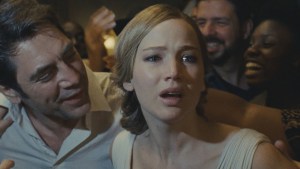
The entire cast is excellent, with Pfeifer leaving a particular impression of sexualized malice. Bardem showcases his ability to turn on a dime from unsympathetic monster to charming lover, while Lawrence harnesses her soft features to imbue Mother with a virginal meekness.
None of the characters are given names, with Lawrence being credited simply as “Mother” and Bardem as “Him”. This reinforces their status as archetypes – representing husband and wife, the artist and the muse, God and Mother Nature, or real-life Aronofsky and Lawrence depending on how you read the film. And the film invites all of these interpretations through its deliberate use of metaphor and symbolism.
“It works on so many levels!”
Whatever your interpretation of Mother!, it is probably correct. On first viewing, I noted at least three possible levels. On the literal level, the film is about Mother’s sacrifice for the art and fame of her narcissistic other — a subversive tale about love and marriage. The continual references to the age gap between Mother and Him seem a deliberate nod to the real life pairing of Lawrence (27) and Aronofsky (48).
On a more general level, it speaks to how artists exploit their relationships as creative fodder and struggle to love anyone as much as they love their work. There is a strong tension between Bardem’s frustrated drive for artistic creation (his writing) and Lawrence’s frustrated drive for another form of creation (a child). The guests seem like projections of Bardem’s desire for fame and worship.
On yet another level, it functions as a Biblical allegory for God’s creation of humanity and our subsequent pillaging of Mother Nature and murder of the Savior – all for the glorification of a cruel Creator. Aronofsky has confirmed that he wrote the screenplay with Biblical themes in mind.
None of these levels are hard to find if you’re looking for them. If anything, Mother! suffers from too much heavy-handed symbolism. Aronovsky piles on dark omens without the erotic finesse of fellow surrealist David Lynch. Yet the cumulative effect and richness of allegory are hard to ignore.
I ❤️ Mother?
Do all these puzzle pieces add up to a compelling experience? Here, I found Mother! to be a mixed bag. The first half of the film was as tense and foreboding as anything I’ve seen. It gripped my attention and never let go. But as we enter the final act, I wondered where it’s all going. You see Mother reliving the same conflict over and over – new intruders arrive, she is too timid to fight back, and her husband merrily gives free reign to his sycophants.
Why doesn’t she leave the house? Why doesn’t she even raise her voice? The repetition is frustrating and starts to feel like the type of nightmare where you’re trying over and over to get somewhere and just can’t. No doubt this is partly intentional, but that doesn’t make it any easier to watch.
Just when Mother! seems about to run out of steam, the film accelerates into a climax so hellish and stunning that it’s still rattling around in my brain. “Over the top” hardly begins to qualify the fearless excess. This is the feverish intensity we expect from Arronovsky that sears into our souls.
If you don’t like other Aronofsky films, you probably won’t like Mother!. It is flawed, portentous and punishing. It’s unlikely that a film this ambitious is ever going to be totally successful. In fact – and I mean this as a compliment – it’s a miracle that this movie was even made.
Only Aronofsky could secure such a stellar cast and big studio release for a film so unfriendly to mainstream audiences. Only Aronofsky, religious critics be damned, has showed such a sustained interest in theological themes and audacious symbolism. In a movie landscape dominated by sequels and remakes, that is something to be thankful for. Mother! may be easy to criticize, but it is nearly impossible to forget.
 Second Sailing