One of the toughest decisions of unemployment is whether to go full blown hipster. Because of professional dress codes, there is an upper limit to how cool one can be while holding down a corporate job. Without such limits, one is free to push the envelope of facial hair, thrift shop clothes and creative headwear.
The real question isn’t whether to go hipster, but how far to go on the graduated scale of hipsterdom. In the working world, one is limited to the lower third of the hipster scale (with the exception of industries like bartending). As the influence of Silicon Valley hoody culture has crept into more traditional industries, the tolerance of hipster leanings has increased. Skinny jeans, colorful socks, black-rimmed glasses and even some forms of beards are all acceptable in the modern corporation.
In fact, dressing with a certain amount of style at work can be rewarded. Companies are eager to emulate the success of their Silicon Valley peers, so anyone who appears to embody the culture of a trendy start-up can be seen as a hipster sherpa who possesses the magic pixie dust to transform their stodgy company into a cutting-edge tech unicorn.
The permeation of the workplace with hipster trappings can lead to frustration from those with more traditional inclinations. In a famous scene from The Social Network, Eduardo is ostracized for wearing suits and loudly voices his disapproval:
Despite the hipsterization of the workplace, there are clear and inviolable limits to the amount of hipsterism that will be tolerated in an office environment. Man buns, above-the-neck tattoos, and beards longer than an inch are guaranteed to raise eyebrows and limit one’s career opportunities.
When one steps outside the corporate world, these shackles are removed. Want to dress like a waifish lumberjack? A Victorian gentleman? Or an artistic vagabond? All doors are open to you. The responsibility to choose rests solely with you.
In a neighborhood like East Austin, the delineation of full hipsters from mere weekend warriors is quite stark. Those who merely role-play hipsters on nights and weekends are clearly distinguishable from those who embrace it as a full-time profession. Full-time hipsterism often goes hand-in-hand with a “job” such as a craft beer brewer, mixologist, or studio-renting collage artist.
Why should one consider going full hipster? The simple answer is because one can. The opportunity to stop shaving and grow an unruly beard or wear ridiculously affected clothing is rare and difficult to pass up. And while it may feel more natural to continue dressing normally, one never knows if there is a full blown hipster trapped inside and waiting to be let out.
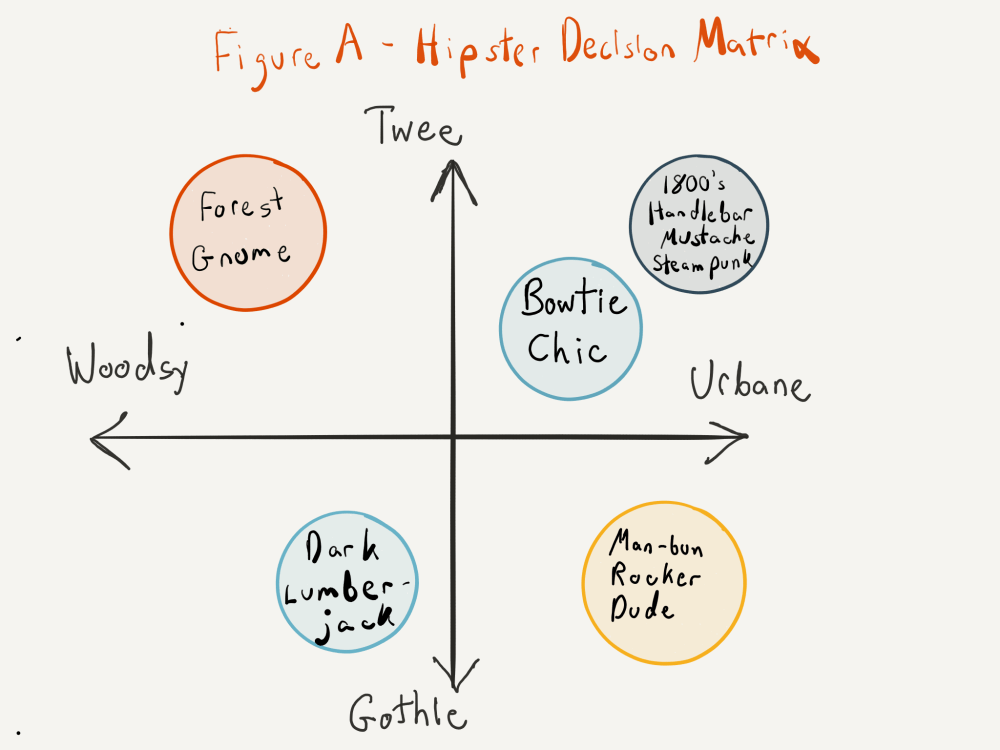
More importantly, what type of full hipster should one be? I’ve sketched a simple matrix to illustrate the range of possibilities (Figure A below). Without a doubt, even this matrix oversimplifies the vast and variegated taxonomy of modern hipsters. But by choosing a quadrant on the matrix, I can begin to narrow down and determine the exact coordinates of where I want to move on the spectrum from working stiff to full hipster.
 Second Sailing